AI Agents in the Browser: What Frontend Engineers Should Actually Prepare For
By Ghazi Khan | Dec 21, 2025 - 5 min read
AI in frontend development has officially crossed an important line.
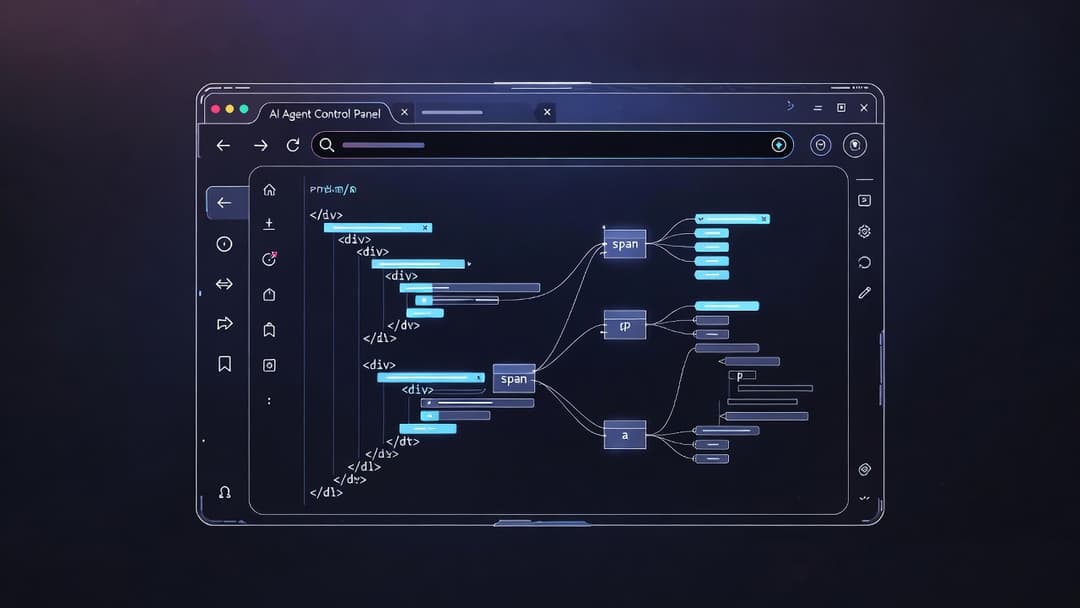
We are no longer talking only about copilots that autocomplete code in an editor. We are now seeing AI agents running inside the browser itself, interacting with the DOM, clicking buttons, filling forms, navigating flows, and completing multi‑step tasks like a human user would.
Tools like Claude’s Chrome‑resident agent and early signals around AI‑native browsers are not experiments anymore. They are previews of a shift that frontend engineers will have to account for whether they like it or not.
This post is not hype.
It’s a grounded look at what actually changes for frontend engineering when AI agents live inside the browser.
What Do We Mean by “AI Agents in the Browser”?
An AI browser agent is not just an API call.
It typically has the ability to:
- Read and understand the DOM
- Trigger real user events (click, input, submit)
- Navigate routes and pages
- Observe layout, text, and UI state
- Perform multi‑step workflows autonomously
From a frontend perspective, this means your UI is no longer consumed only by humans and test runners.
It is also consumed by reasoning systems that can act.
That changes assumptions.
Why This Matters to Frontend Engineers (Not Just AI Teams)
If you build UI at scale, this affects you in at least four concrete areas.
1. DOM Is Becoming an API Surface
For years, frontend engineers treated the DOM as an internal implementation detail.
AI agents change that.
They rely heavily on:
- Semantic HTML
- Stable element roles
- Accessible labels
- Predictable UI state transitions
If your app is built with deeply nested divs, fragile selectors, or visually correct but semantically empty markup, agents will struggle just like screen readers do.
This pushes frontend teams toward:
- Stronger accessibility practices
- Clear component boundaries
- Consistent DOM structure
Accidentally, this is also good engineering.
2. UI Automation Is No Longer Just Testing
Historically, browser automation meant:
- Playwright
- Cypress
- Selenium
These tools are deterministic and script‑driven.
AI agents are goal‑driven instead.
That means:
- They adapt to UI changes
- They infer intent
- They tolerate small layout shifts
For frontend teams, this blurs the line between:
- E2E testing
- User onboarding automation
- Support workflows
- QA tooling
Your UI is now part of an automation ecosystem, not just a rendering layer.
3. Frontend State Management Becomes Observable
AI agents do not just click buttons they observe outcomes.
They infer success or failure based on:
- Text changes
- Disabled states
- Loading indicators
- Error messages
If your frontend state is:
- Inconsistent
- Implicit
- Hidden behind animations or side effects
Agents will misinterpret it.
This puts pressure on teams to:
- Make UI states explicit
- Standardize loading and error patterns
- Reduce magic behavior
Again, this is not a downside, it’s architectural hygiene.
4. Security and Abuse Models Need Rethinking
AI agents can:
- Fill forms at scale
- Navigate protected flows
- Mimic human interaction patterns
This complicates:
- Bot detection
- Rate limiting
- Abuse prevention
Traditional CAPTCHA‑style defenses are already brittle. Agent‑driven browsers make them even less reliable.
Frontend engineers will increasingly collaborate with backend and security teams on:
- Intent‑based validation
- Behavioral heuristics
- Server‑side verification of critical actions
Security is no longer just a backend concern.
What Should Frontend Teams Actually Prepare For?
Here is the practical checklist, no speculation.
✔ Invest in Semantic HTML and Accessibility
Not for compliance.
For resilience.
Accessible UIs are machine‑readable UIs.
✔ Treat UI State as a Contract
If a user or agent completes an action, the UI should clearly reflect it.
Avoid ambiguous states.
✔ Expect Non‑Human Consumers of Your UI
Your app will be used by:
- Humans
- Tests
- AI agents
Design accordingly.
✔ Stop Over‑Optimizing for Fragile DOM Structures
If a minor markup refactor breaks workflows, the architecture is already fragile.
Agents will expose this quickly.
What This Is Not
Let’s be clear.
This is not the end of frontend engineering. This is not AI replacing UI developers. This is not something you need to rewrite your stack for tomorrow.
But it is a signal.
Just like SPAs, SSR, and server components changed how we think about UI boundaries, browser‑resident AI agents change how UIs are consumed.
Ignoring that would be irresponsible.
Final Thoughts
Frontend engineering is slowly shifting from:
“How does this look to a user?”
to
“How does this behave as a system?”
AI agents in the browser accelerate that shift.
The teams that win will not be the ones chasing AI buzzwords. They’ll be the ones building clear, observable, resilient UIs the kind that humans and machines can both understand.
And honestly?
That’s the kind of frontend engineering worth doing.
Related Reads
Advertisement
Ready to practice?
Test your skills with our interactive UI challenges and build your portfolio.
Start Coding Challenge