Svelte 5 vs React 19: Performance Myths vs Production Reality
By Ghazi Khan | Jan 14, 2026 - 4 min read
If you spend enough time on frontend Twitter or Reddit, you’ve seen the same argument repeat every few months:
“Svelte is faster than React.”
On paper, that statement is often true.
In production, it’s usually irrelevant.
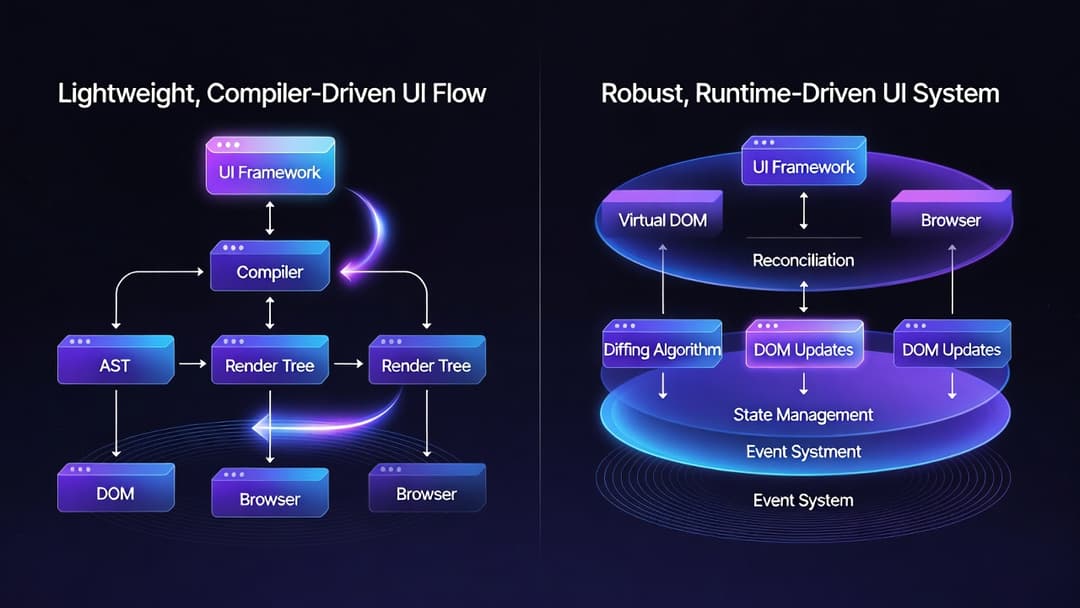
Svelte 5 and React 19 represent two very different philosophies of frontend engineering. One optimizes aggressively at compile time. The other prioritizes runtime flexibility, safety, and scale.
This article isn’t about who wins micro-benchmarks.
It’s about what actually matters when you’re shipping, maintaining, and scaling real-world applications.
The Core Difference: Compiler vs Runtime
Everything about this debate starts here.
Svelte 5: Compiler-First
Svelte does most of its work before your app ever reaches the browser.
- Components compile into minimal imperative JavaScript
- No virtual DOM diffing at runtime
- Updates target specific DOM nodes
The result is:
- Smaller runtime
- Fewer abstractions in the browser
- Very fast initial interactions
React 19: Runtime-Oriented
React intentionally keeps its abstraction in the runtime.
- Virtual DOM reconciliation
- Concurrent scheduling
- Streaming and Server Components
This costs more at runtime but enables:
- Predictable updates at scale
- Advanced rendering strategies
- Safer composition in large teams
This is not an accident. It’s a tradeoff.
Why Svelte Often Wins Benchmarks
Let’s address the obvious.
In isolated benchmarks:
- Svelte frequently shows faster mount times
- Smaller bundles for simple apps
- Less JavaScript execution on initial render
That’s expected.
A compiler that emits minimal DOM operations will almost always beat a general-purpose runtime in synthetic tests.
The Problem With Benchmarks
Most benchmarks:
- Test small, artificial components
- Ignore data fetching and caching
- Don’t model real interaction patterns
- Run in ideal conditions
Production apps are not ideal conditions.
What Actually Dominates Performance in Production
Here’s the uncomfortable truth.
In real applications, performance is dominated by:
- Network latency
- Data fetching strategy
- Caching and memoization
- Rendering architecture (SSR, streaming, islands)
- Bundle splitting and asset strategy
Framework choice usually ranks below all of these.
A poorly architected Svelte app will feel slower than a well-architected React app every time.
React 19’s Real Strength: Predictability at Scale
React 19’s biggest advantage is not speed.
It’s predictability.
Concurrent Rendering
React can:
- Pause rendering
- Resume work
- Prioritize user interactions
This matters enormously in complex UIs where multiple updates compete for resources.
Server Components
React 19’s Server Components allow:
- Smaller client bundles
- Secure server-only logic
- Streaming UI without blocking
These are architectural tools, not performance tricks.
They scale with team size and application complexity.
Svelte 5’s Real Strength: Simplicity and Focus
Svelte shines when:
- Apps are small to medium-sized
- Teams are lean
- UI logic is straightforward
- You want minimal abstraction overhead
The mental model is simple:
State changes → DOM updates
That simplicity translates to faster onboarding and fewer layers to debug.
For many products, that’s a massive win.
The Hidden Cost: Tooling and Ecosystem Depth
Performance discussions often ignore tooling.
React’s Ecosystem Advantage
React offers:
- Mature devtools
- Extensive linting and profiling
- Battle-tested patterns
- Large hiring pool
These don’t show up in benchmarks, but they absolutely affect delivery speed.
Svelte’s Tradeoff
Svelte’s ecosystem is improving fast, but:
- Debugging tools are less mature
- Fewer established architectural patterns
- Smaller talent pool
None of these are dealbreakers but they matter at scale.
So… Which One Is “Faster”?
Here’s the honest answer.
Svelte 5 Is Faster When:
- The app is interaction-heavy but structurally simple
- You control most of the UI state
- Initial load performance is critical
React 19 Wins When:
- The app is large and long-lived
- Multiple teams contribute
- Rendering strategies matter more than raw speed
- Predictability and safety outweigh micro-gains
The wrong question is:
“Which framework is faster?”
The right question is:
“Which framework fails more gracefully at scale?”
Decision Matrix (Practical Guidance)
- Startup MVP: Svelte 5
- Design-heavy product: Svelte 5
- Enterprise dashboard: React 19
- Multi-team platform: React 19
- Long-term maintainability: React 19
There is no universal winner only context.
Final Thoughts: Stop Optimizing the Wrong Thing
Frontend performance debates often focus on what’s easiest to measure, not what’s most impactful.
Svelte 5 proves how far compiler-driven UI can go.
React 19 proves that predictability, tooling, and architecture matter more than shaving milliseconds off synthetic tests.
Senior engineers don’t choose frameworks to win benchmarks.
They choose frameworks to sleep better after deployment.
Related Reads
Advertisement
Ready to practice?
Test your skills with our interactive UI challenges and build your portfolio.
Start Coding Challenge